
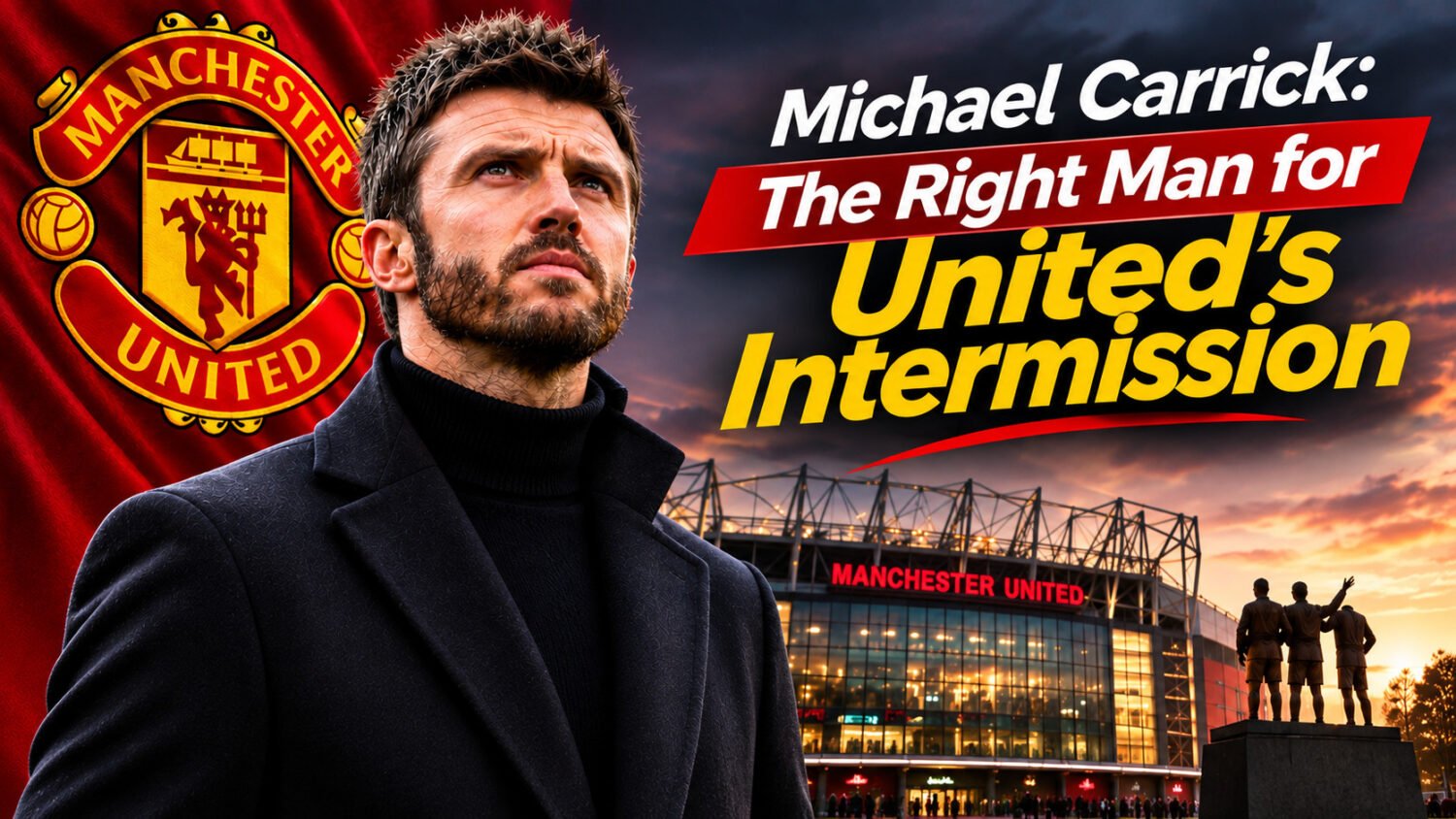
Perhaps Manchester United are asking the wrong question about Michael Carrick.
The debate surrounding the manager inevitably gravitates towards permanence.
Is Carrick good enough to be Manchester United’s long-term manager?
Can he win the Premier League?
Can he restore United to the summit of European football?
Should the club replace him when a more established coach becomes available?
These are reasonable questions.
But they may be questions for another day.
Because Manchester United do not necessarily need to decide today whether Michael Carrick should manage the club for the next five years.
They need to decide who should manage Manchester United while the club figures out what the next five years are supposed to look like.
That changes the conversation completely.
Perhaps Carrick is not an interim manager at all.
Perhaps Manchester United are an interim football club—and there may be nobody better suited to lead them through that intermission.
United need a bridge before they need a destination
Manchester United are still being rebuilt.
Not simply the team.
The club.
INEOS inherited a football operation requiring changes to recruitment, sporting leadership, infrastructure, squad planning and the broader culture surrounding the first team.
Those things cannot be reconstructed in a summer.
Yet the temptation at Manchester United is always to behave as though the next managerial appointment will solve everything.
Find the right coach.
Give him some players.
Return to winning.
It sounds simple.
The previous decade should have taught United that it isn’t.
The club first needs to determine what Manchester United football should actually look like.
What formation or tactical principles should survive changes of manager?
What characteristics should recruitment prioritise?
Which existing players belong in the next competitive United side?
Where does the academy fit?
How should United press?
How should they build possession?
What standards should define the dressing room?
Only when those questions have clear institutional answers does appointing the “next great Manchester United manager” become significantly easier.
Until then, United need a bridge.
And Michael Carrick may be an unusually good one.
Stop judging Carrick only as the final answer
This is where expectations need recalibrating.
Carrick does not need to be Pep Guardiola.
He does not need to become the next Sir Alex Ferguson.
He doesn’t even need to prove immediately that he is the manager who will eventually win United’s next Premier League title.
He needs to make Manchester United healthier than he found it.
That is a different assignment.
Build a functional squad.
Develop young players.
Restore confidence.
Establish standards.
Help define a recognisable football philosophy.
Create an environment in which players can improve.
Remove those who cannot contribute to what comes next.
And hand either himself or his eventual successor a football team rather than another collection of expensive pieces.
If Carrick accomplishes that, his tenure will have been successful regardless of who eventually manages Manchester United.
Because Carrick offers something another appointment cannot buy
Carrick knows Manchester United.
That phrase can sometimes become sentimental shorthand, but in this situation it matters.
He knows what Old Trafford feels like when expectations become enormous.
He knows the scrutiny.
He knows what supporters expect from United players because he spent more than a decade being one.
He understands the traditions of the club without appearing trapped by them.
Most importantly, his relationship with Manchester United is not transactional.
Carrick doesn’t need someone to explain what the institution means.
He lived it.
There is also goodwill between Carrick and significant sections of the fanbase.
That goodwill is valuable currency during reconstruction.
A new manager arriving with a large reputation would immediately create large expectations.
A few major signings would increase them further.
Within months, every result would again become a referendum on whether Manchester United were “back.”
Carrick offers something different.
He can give United room to build.
And his players will play for him
Carrick’s ability to connect with players should not be underestimated either.
Football tactics matter enormously.
But players are human beings.
Confidence matters.
Trust matters.
Belief matters.
The willingness to run another five metres for a manager matters.
Carrick has already demonstrated an ability to produce performances when United desperately need them.
That doesn’t mean every performance will be excellent or every tactical decision correct.
It means there is enough evidence to believe that Carrick can keep the football team competitive while the institution around it is being rebuilt.
For a transitional period, that is enormously valuable.
United don’t need chaos while trying to eliminate chaos.
They need stability.
Give Carrick a different mandate
This requires INEOS to redefine what success looks like.
Instead of telling Carrick:
“Qualify for the Champions League or your job is in danger.”
The mandate should be broader.
Build us the foundation of the next Manchester United.
Of course results still matter. Manchester United cannot simply accept mediocrity indefinitely.
But the sporting directorate should also measure development.
Is the squad becoming younger, stronger and more coherent?
Are United recruiting players according to a consistent profile?
Are academy players being integrated intelligently?
Is there a recognisable style emerging?
Are expensive mistakes being moved out?
Are players improving?
Are standards becoming clearer?
Is the next transfer window solving existing problems rather than creating new ones?
Those indicators tell us considerably more about rebuilding than whether United finish fourth or sixth in one particular season.
Build the squad before choosing its ultimate manager
There is also a strategic advantage.
Manchester United have repeatedly appointed managers and then rebuilt squads around their individual preferences.
When the manager leaves, the next coach inherits players recruited for somebody else’s football.
Then another rebuild begins.
INEOS can reverse that relationship.
Build Manchester United’s squad first.
Define Manchester United’s football philosophy first.
Establish Manchester United’s recruitment model first.
Then, if Carrick eventually leaves, appoint the best manager for the football structure that already exists.
Suddenly the question changes from:
“Who is the biggest manager available?”
to:
“Who is the best coach for Manchester United’s established system?”
That is how mature football organisations think.
And Carrick can help United reach that point without demanding that the entire institution be redesigned around Michael Carrick.
That may actually make him more valuable right now than a glamorous alternative.
And something unexpected could happen
There is another possibility.
Carrick might become the long-term answer.
That should neither be assumed nor dismissed.
Give him two seasons of intelligent recruitment.
Give him a functioning sporting structure.
Allow him to develop players.
Let him establish his football.
Then evaluate him.
Perhaps United discover his ceiling.
Perhaps they conclude that the rebuilt squad requires an elite coach capable of taking the final step.
Fine.
Carrick would leave behind a healthier Manchester United.
But perhaps something else happens.
Perhaps Carrick grows with the team.
Perhaps the manager becomes better as the squad becomes better.
Perhaps tactical sophistication develops with experience.
Perhaps the man hired to oversee the transition becomes impossible to replace because somewhere along the journey the transition becomes success.
United lose nothing by allowing that possibility to reveal itself naturally.
They lose considerably more by forcing another premature decision.
The intermission matters
An intermission is not the end of the story.
It is the space between acts.
Manchester United have spent too long desperately trying to recreate their greatest act without properly preparing the next one.
Perhaps this period should be treated differently.
Don’t pretend the reconstruction is complete.
Don’t manufacture another “new era.”
Don’t promise supporters that one appointment changes everything.
Acknowledge where the club actually is.
Manchester United are between versions of Manchester United.
The old structure has gone.
The new one is still being constructed.
The squad remains unfinished.
The football identity remains under development.
The culture is being restored.
That is not failure.
It is transition.
And transitions require different kinds of leadership.
Sometimes the person best suited to build an organisation is not the person ultimately chosen to lead it at maturity.
But occasionally, if you give that person enough time, trust and resources, they grow alongside what they are building.
Michael Carrick knows Manchester United.
He respects Manchester United.
He understands its expectations.
He believes in its players.
And importantly, supporters understand him.
So stop asking whether Carrick is Manchester United’s permanent manager.
There will be time for that question.
For now, give him something more important to do.
Let him stabilise the team.
Let him help build the squad.
Let him establish standards.
Let INEOS define the philosophy around him.
Let Manchester United discover what Manchester United are supposed to become.
And when that work is complete, the club can decide who should lead the next act.
It might be someone else.
It might even still be Michael Carrick.
Either way, United will finally be making that decision from a position of strength.
Because Michael Carrick does not need to be Manchester United’s interim manager.
Manchester United need to accept that they are the ones in intermission.
And there may be no better man to guide them through it.
Comments
No comments yet. Join the conversation.
Join the conversation. Log in to leave a comment.
Log in to comment