
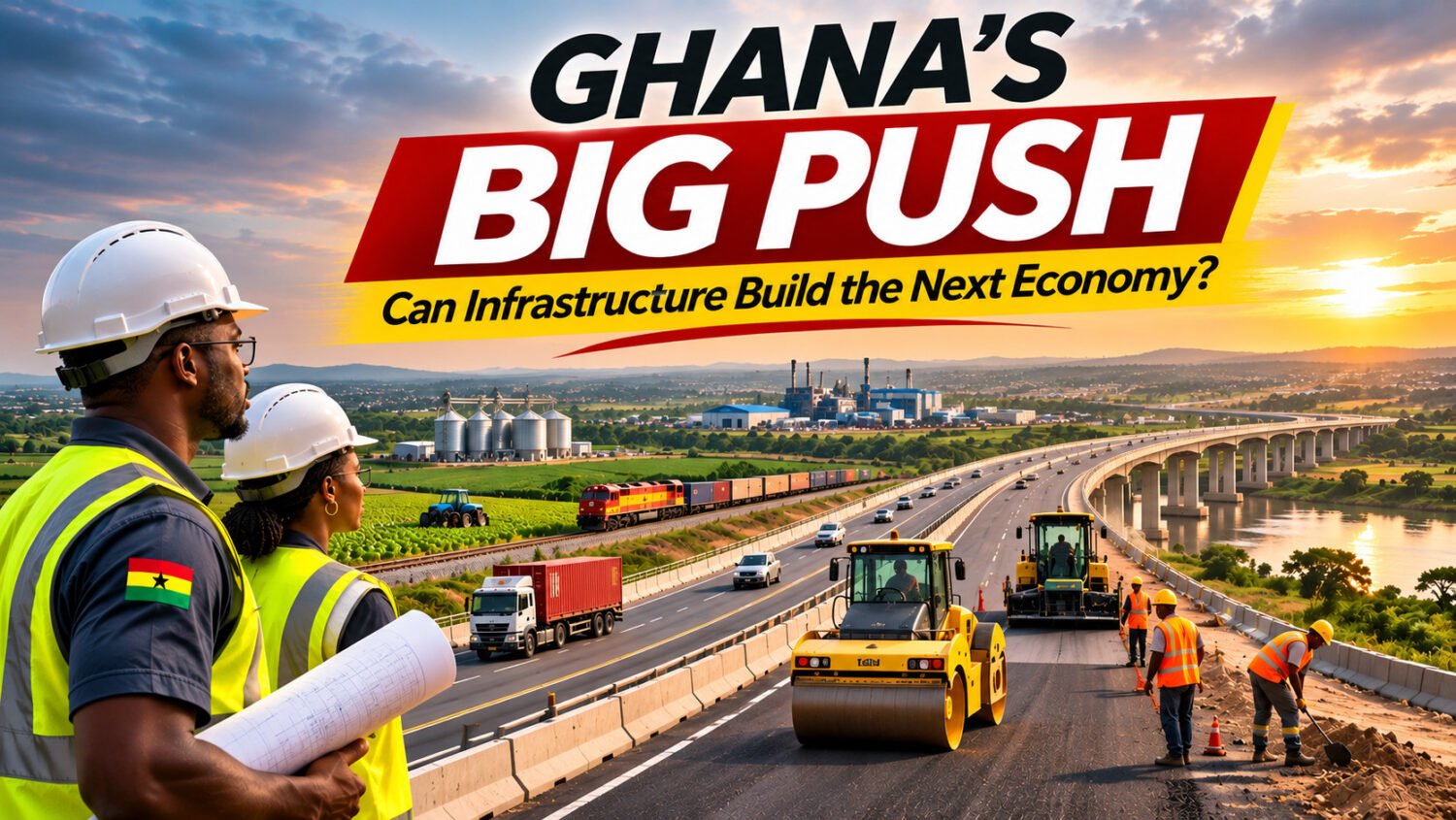
There is something undeniably compelling about a country building.
Roads appear where journeys once took hours.
Bridges connect communities separated by rivers.
Railways move goods that previously travelled expensively by truck.
Construction sites employ thousands of people.
And slowly, the physical map of an economy begins to change.
That is the ambition behind Ghana’s Big Push Infrastructure Programme.
The government describes it as a US$10 billion infrastructure programme intended to develop roads, bridges, ports and logistics corridors, with infrastructure ultimately extending across sectors including energy, water, sanitation, health, education and housing. The 2026 Budget describes it as an attempt to make infrastructure the backbone of industrialisation and economic opportunity.
It is an ambitious idea.
And Ghana needs ambition.
But there is a distinction we should make early.
Building infrastructure is not the same thing as building an economy.
The first can enable the second.
It does not guarantee it.
That distinction may ultimately determine whether the Big Push becomes another collection of government projects—or one of the foundations of Ghana’s next economic transformation.
Ghana has an infrastructure problem
Anyone who moves goods around Ghana understands this.
A farmer can produce food and still lose money because getting it to market is difficult.
A manufacturer can build a good product and still struggle because logistics make that product expensive.
A business can locate outside Accra and discover that poor connectivity immediately becomes a competitive disadvantage.
A journey that should take two hours takes four.
Vehicles deteriorate faster.
Fuel consumption rises.
Food spoils.
Businesses build transportation inefficiencies into their prices.
Consumers ultimately pay for all of it.
The government itself identifies poor roads connecting food-producing areas to markets as one contributor to food inflation. Its response includes a three-year programme for 1,000 kilometres of agricultural enclave roads intended specifically to connect production areas to markets.
This is where infrastructure becomes economics.
A road is not valuable merely because cars can travel on it.
A road becomes economically transformative when it reduces the cost of doing something productive.
That should become the test of the Big Push.
Every road should answer an economic question
Suppose Ghana builds a beautiful highway.
What does it connect?
A farming region to a processing centre?
A manufacturing zone to Tema or Takoradi?
A mining area to rail?
Workers to an industrial park?
Tourists to a destination?
Traders to neighbouring countries?
If the answer is unclear, we should question why that road is being prioritised.
Infrastructure should follow an economic map.
Imagine, instead, that Ghana deliberately identifies its major productive zones.
Agricultural belts.
Mining regions.
Manufacturing centres.
Ports.
Border crossings.
Tourism corridors.
Emerging cities.
Then we connect them.
Road.
Rail.
Electricity.
Water.
Digital infrastructure.
Storage.
Logistics.
Suddenly infrastructure stops being a collection of projects.
It becomes a production system.
That is the version of the Big Push Ghana should pursue.
The Accra-Kumasi corridor illustrates the opportunity
One of the programme’s most ambitious proposed additions is a new Accra-Kumasi Expressway.
The 2026 Budget describes a 198.7-kilometre, six-lane Class A expressway connecting Greater Accra through the Eastern Region to Ashanti.
Think beyond travel time.
Accra and Kumasi are two enormous centres of consumption, labour and commerce.
What happens if movement between them becomes substantially faster and more predictable?
Warehousing becomes easier.
Distribution becomes cheaper.
Manufacturers can serve larger markets.
Businesses can locate farther from Accra without becoming commercially isolated.
Land along strategic interchanges becomes economically valuable.
Entire secondary commercial centres can emerge.
That is how infrastructure creates economic geography.
But only if planning anticipates it.
Otherwise we simply get a faster journey between two cities.
Useful, certainly.
Transformative?
Not necessarily.
Roads must connect to farms and factories
This is why the relationship between the Big Push and Ghana’s agricultural strategy matters.
Government says trunk roads will initially be prioritised before feeder-road connections are progressively expanded. President Mahama has described a multi-phase approach moving from major corridors toward the roads connecting towns and communities.
That sequencing makes sense.
But eventually the network must reach production.
A tomato farmer does not benefit sufficiently from a world-class highway 80 kilometres away if the first 30 kilometres from the farm remain almost impassable.
Neither does a factory benefit from excellent highways if electricity remains unreliable.
This is where Ghana must resist thinking about infrastructure ministry by ministry.
Roads cannot exist independently from agriculture.
Agriculture cannot exist independently from energy.
Energy cannot exist independently from industry.
Industry cannot exist independently from ports.
Ports cannot exist independently from rail and roads.
And increasingly, none of them can exist independently from digital connectivity.
The Big Push becomes truly interesting when those systems begin operating as one.
Rail may be even more important than we realise
Government has also indicated that the Western Rail Line could be incorporated into the Big Push.
The economic logic is straightforward.
The Western corridor contains major mineral and agricultural activity. President Mahama has specifically connected completion of the railway with moving bauxite, manganese and cocoa more efficiently towards Ghana’s ports.
This is precisely how infrastructure should be evaluated.
What productive activity does it unlock?
What cost does it reduce?
What investment becomes viable because this exists?
Those questions should precede construction.
Not follow it.
But Ghana must confront the other side of infrastructure
Big infrastructure creates big opportunities.
It also creates big opportunities for waste.
Poorly selected projects.
Inflated contracts.
Abandoned construction.
Cost overruns.
Political roads that make little economic sense.
Projects launched by one government and neglected by another.
And maintenance postponed until expensive infrastructure deteriorates.
The Big Push has already attracted scrutiny over procurement.
In April, the Ghana Institution of Engineering called for an independent audit, citing the scale of expenditure and concerns raised about procurement and execution. A subsequent presidential investigation concluded that the Roads Ministry had acted within procurement law, while the President accepted reforms intended to strengthen procurement controls.
That scrutiny should not be regarded as an obstacle to the programme.
It should be part of the programme.
When billions are being converted into concrete, asphalt and steel, transparency is infrastructure too.
Maintenance must be part of the Big Push
Ghana also needs to abandon one particularly expensive habit:
building things we subsequently fail to maintain.
Infrastructure is not completed when the ribbon is cut.
That is when its economic life begins.
The 2026 Budget says routine and periodic maintenance covered more than 21,000 kilometres of trunk, urban and feeder roads, with another 25,000 kilometres targeted for maintenance in 2026.
That philosophy must survive beyond a single budget.
Every major Big Push project should have a maintenance plan.
Who maintains it?
How often?
From what funding source?
At what expected annual cost?
If Ghana builds a road designed to last 20 years but allows drainage to fail in year four, we have not saved money.
We have simply postponed another bill.
Give Ghanaian companies room to grow
There is another opportunity hidden inside the programme.
Construction itself can become industrial policy.
Government says the Big Push is intended partly to empower local contractors and strengthen domestic industries connected to construction and manufacturing.
That should be taken seriously.
If billions are being spent on infrastructure, how much of that money remains inside Ghana?
Who supplies the cement?
Who fabricates components?
Who provides engineering services?
Who maintains equipment?
Who supplies technology?
Who trains apprentices?
Who develops the next generation of Ghanaian engineers?
A successful Big Push should leave behind more than roads.
It should leave behind stronger Ghanaian companies capable of building the next roads without needing the same level of external dependence.
That is how government expenditure develops productive capacity.
Measure economic outcomes, not ceremonies
Perhaps every Big Push project should eventually have a public economic scorecard.
Not merely:
85% complete.
Tell us what changed.
Travel time before and after.
Transport cost before and after.
Agricultural losses before and after.
Traffic volumes.
Businesses established along the corridor.
Jobs created.
Export volumes.
Private investment attracted.
Maintenance expenditure.
Regional economic activity.
Then Ghanaians could judge infrastructure based on outcomes rather than political claims.
Government could demonstrate success.
Journalists could interrogate performance.
Researchers could analyse impact.
Investors could identify opportunity.
And future governments could learn which infrastructure investments actually produced the greatest returns.
That would change the national conversation.
Build beyond governments
The Big Push also presents Ghana with a familiar institutional challenge.
Infrastructure lasts longer than political terms.
A highway begun under one administration may be completed under another.
A railway may require several governments.
An industrial corridor may take a decade before its full economic effect becomes visible.
Ghana therefore cannot afford infrastructure planning that resets every four or eight years.
Projects with demonstrable economic value should belong to Ghana.
Not to a party.
Not to a president.
Not to a minister.
Ghana.
That requires transparent project selection, credible feasibility studies, stable financing and enough public information that abandoning a viable project becomes politically harder than completing it.
The Big Push can become something bigger
There is a version of this programme that is primarily about roads.
And there is another version that is about redesigning Ghana’s economic geography.
We should choose the second.
Connect farms to processors.
Processors to rail.
Rail to ports.
Workers to industrial zones.
Cities to markets.
Businesses to reliable electricity.
Communities to digital networks.
Then give Ghanaian companies opportunities to participate in building and maintaining those systems.
Do that successfully and the Big Push stops being an infrastructure programme.
It becomes an economic strategy.
That is the standard against which it should ultimately be judged.
Not how many kilometres were constructed.
Not how many sod-cutting ceremonies were held.
Not which government initiated which project.
Ask something more important:
What became possible because we built this?
Did food become cheaper to transport?
Did factories emerge?
Did exports increase?
Did businesses invest?
Did regional economies grow?
Did Ghanaian companies become stronger?
Did ordinary people become more productive?
Because concrete alone does not create prosperity.
Connectivity does not automatically create productivity.
And spending money does not necessarily create wealth.
But infrastructure designed around production, maintained properly, procured transparently and connected deliberately to a national economic strategy can change the trajectory of a country.
Ghana needs roads.
Ghana needs railways.
Ghana needs bridges, ports, energy, irrigation and digital infrastructure.
So yes, Ghana needs a Big Push.
But the ambition should be bigger than construction.
We should not simply build roads across Ghana.
We should use those roads to build the next Ghanaian economy.
Comments
No comments yet. Join the conversation.
Join the conversation. Log in to leave a comment.
Log in to comment