
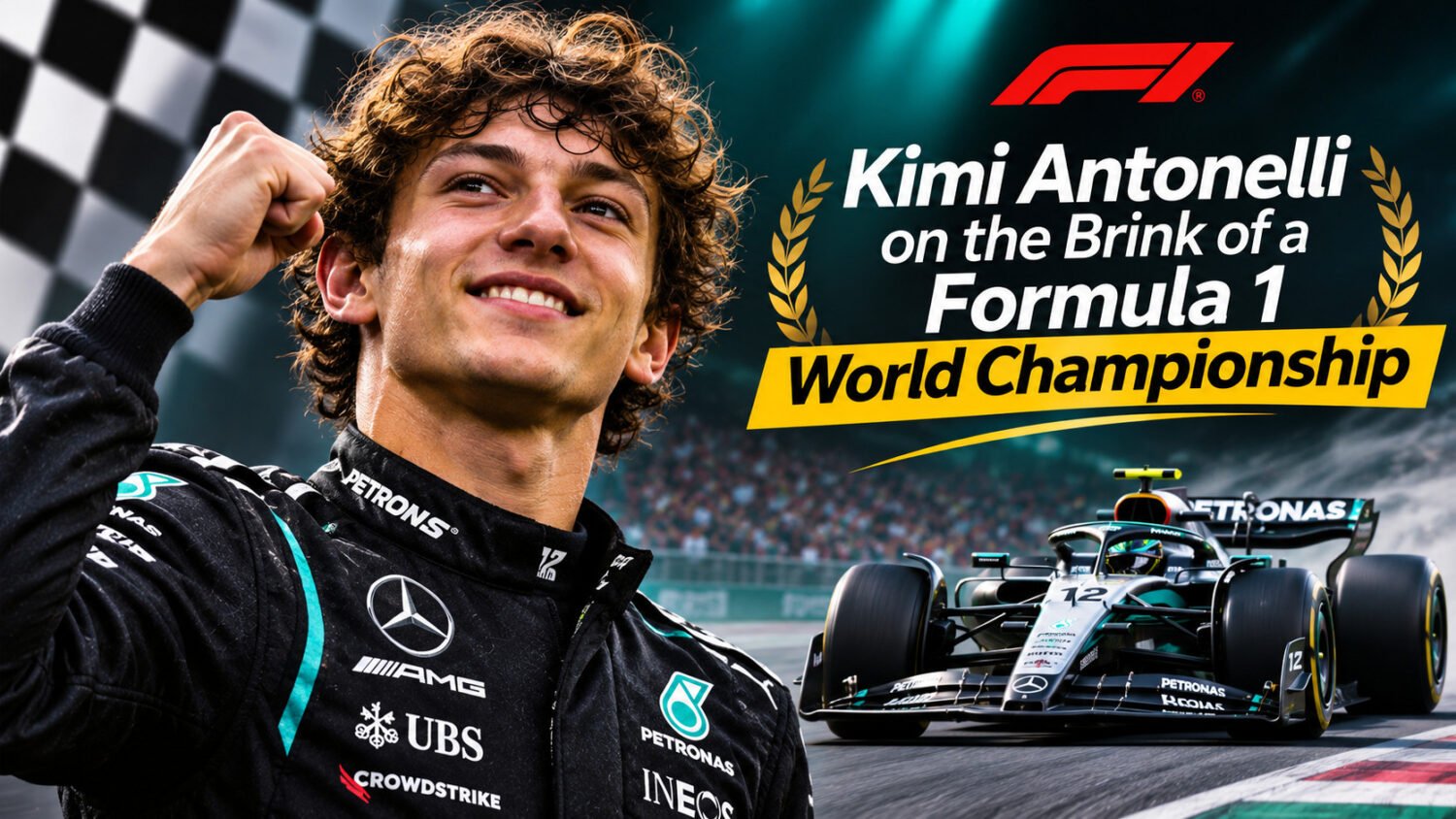
Kimi Antonelli needs two points.
After an extraordinary Formula 1 season spanning continents, changing regulations, established champions and some of the fastest drivers on Earth, the equation facing the 20-year-old Italian in Mexico is almost absurdly simple.
Finish ninth or better and Andrea Kimi Antonelli will become Formula 1 World Champion.
He could even leave Mexico as champion without scoring at all, provided neither George Russell nor Lewis Hamilton wins the race.
Antonelli arrives with 365 points, 123 ahead of Mercedes teammate Russell and 124 ahead of Hamilton. Only 125 points remain available across the final five rounds.
The championship is not mathematically his yet.
But it is close enough that we can begin asking the more interesting question.
How did this happen so quickly?
Because Antonelli’s impending championship is not merely the story of a very fast Mercedes.
It is the story of talent meeting opportunity, preparation meeting pressure and a young man discovering that sometimes the moment you have spent your life preparing for arrives much earlier than expected.
And when it does, you have to be ready.
The boy Mercedes refused to wait for
Antonelli’s rise to Formula 1 was never conventional.
Mercedes had been preparing him for years.
He entered the Mercedes Junior Team in 2019 and rapidly accumulated championships as he progressed through junior categories. Formula 4 titles arrived. Formula Regional titles followed.
Then Mercedes did something remarkable.
They accelerated the timetable.
Antonelli skipped Formula 3 entirely and moved directly into Formula 2 for 2024.
Then came the decision that placed an extraordinary weight on his shoulders.
Lewis Hamilton was leaving Mercedes for Ferrari.
Mercedes needed his replacement.
There were experienced Formula 1 drivers available.
Instead, Toto Wolff entrusted one of the most famous seats in motorsport to a teenager.
Antonelli made his Formula 1 debut in 2025 at just 18.
The potential was obvious.
So were the growing pains.
There were brilliant moments, including a maiden podium in Canada, but there were also mistakes, difficult weekends and periods when the enormous expectations surrounding him appeared considerably larger than his experience.
That first season produced 150 points and three podiums.
Good.
Promising.
But hardly evidence that Formula 1 was about to be conquered.
Then 2026 happened.
Everything changed in Japan
Antonelli began this season with second place in Australia.
Then he won in China.
And then came Japan.
Victory at Suzuka took Antonelli to the top of the World Championship after only three rounds. More significantly, the result made him the youngest championship leader in Formula 1 history.
He has never surrendered that championship lead.
Think about that.
A 20-year-old competing in only his second Formula 1 season took the championship lead in March and has carried it through almost the entire year while being pursued by George Russell, Lewis Hamilton, Max Verstappen, Charles Leclerc, Lando Norris and Oscar Piastri.
These are not ordinary competitors.
Between them sit world championships, hundreds of podiums and years of experience dealing with exactly the kind of pressure Antonelli had barely encountered.
Yet Antonelli kept winning.
Miami.
Canada.
Monaco.
Belgium.
Then came the race that transformed an excellent championship campaign into something approaching folklore.
Monza
Every great championship season seems to contain one race that people remember differently from the others.
For Antonelli, that race may forever be Monza.
The Italian Grand Prix.
An Italian driver.
The expectation of an entire nation.
And Antonelli started 19th.
An engine-related grid penalty had placed him almost at the back of the field.
What followed was extraordinary.
Antonelli carved his way through the race and eventually crossed the line ahead of teammate George Russell and Max Verstappen.
From 19th to first.
At Monza.
For an Italian.
While leading the Formula 1 World Championship.
There are victories worth 25 points.
And there are victories that become part of a driver’s mythology.
Monza was the latter.
It demonstrated something increasingly important about Antonelli.
He does not seem to require perfect circumstances to win.
That separates very fast drivers from champions.
Nine victories. Fifteen podiums. Seven poles.
The statistics now tell their own story.
Through 18 Grands Prix, Antonelli has recorded nine victories, 15 podiums and seven pole positions. He has finished inside the top 10 in 16 races and failed to finish only once.
That consistency is devastating in a championship.
Consider his sequence.
Second in Australia.
First in China.
First in Japan.
First in Miami.
First in Canada.
First in Monaco.
Then his only retirement of the season in Barcelona.
Third in Austria.
A difficult British Grand Prix followed.
Then victory again in Belgium.
Third in Hungary.
Second in the Netherlands.
Victory at Monza.
Victory in Madrid.
Second in Bahrain.
Third in Singapore.
And then victory in Austin.
Look at what is almost absent from that list.
Disaster.
Championships are not only won by producing spectacular Sundays.
They are won by reducing the number of Sundays when everything disappears.
Antonelli has done both.
Austin showed how much he has grown
If Monza demonstrated Antonelli’s ability to fight through adversity, Austin demonstrated something different.
Control.
Antonelli started from pole and simply managed the United States Grand Prix.
He maintained the lead into Turn 1 and gradually created separation from the battle behind him. By Lap 10 his advantage was already approaching three seconds.
He ultimately won by more than 13 seconds from Charles Leclerc, with Max Verstappen third.
It was his ninth victory of the season.
But perhaps more important was what the victory looked like.
It wasn’t chaotic.
It wasn’t desperate.
It wasn’t the performance of a young driver hanging onto a fast car.
It looked like the performance of a championship leader who understood exactly what was required.
And that may be the most impressive part of Antonelli’s season.
The speed was always expected.
The maturity wasn’t supposed to arrive this quickly.
Mercedes deserves enormous credit
No account of Antonelli’s season can ignore the machine beneath him.
Formula 1 is not an equal-equipment championship.
Mercedes has provided Antonelli with a car capable of fighting at the front, and his teammate sitting second in the championship confirms the competitiveness of the package.
That matters.
Great drivers require great machinery to win championships.
Michael Schumacher needed Ferrari.
Sebastian Vettel needed Red Bull.
Lewis Hamilton’s dominant years were inseparable from Mercedes.
Max Verstappen’s championships were achieved alongside Red Bull’s technical excellence.
Antonelli is no exception.
But the existence of a great car does not explain a 123-point advantage over the man driving the other one.
That is where the driver re-enters the equation.
Russell has won races this season.
Hamilton has won.
Verstappen has won.
The field contains multiple drivers capable of winning on any given weekend.
Antonelli has simply done it more often.
Nine times so far.
The teammate test
Perhaps the most useful measurement of a Formula 1 driver is the person sitting in the other car.
George Russell is not an inexperienced benchmark.
He entered 2026 as the established Mercedes driver and had already demonstrated that he could win Grands Prix and compete at the front.
Yet with five rounds remaining, Antonelli leads him 365–242.
That is not a marginal difference.
It is 123 points.
And because they share the same team, the comparison strips away at least some of the machinery question.
Same organisation.
Same engine.
Same fundamental car.
Different championship.
That doesn’t diminish Russell.
It magnifies Antonelli.
But this championship was built long before 2026
This is where Antonelli’s story becomes relevant beyond motorsport.
Success often appears sudden when viewed from the outside.
A 20-year-old emerges.
He starts winning.
Within two seasons he is apparently about to become World Champion.
And we call him an overnight sensation.
But there is almost never anything overnight about it.
There were years of karting before Formula 1.
Years of junior racing.
Years of Mercedes investment.
Thousands of laps.
Simulator sessions.
Fitness work.
Engineering meetings.
Mistakes.
Data analysis.
Travel.
Sacrifice.
Pressure.
The world tends to notice preparation only when preparation finally produces something visible.
Antonelli’s 2026 season looks extraordinarily fast.
His journey to become capable of producing it wasn’t.
Opportunity rarely arrives when you feel ready
There is another lesson hidden in Antonelli’s rise.
Mercedes could have waited.
Antonelli could have spent another season in Formula 2.
He could have progressed through Formula 3 first.
Mercedes could have placed an experienced driver beside Russell and allowed its young prospect to mature quietly.
Instead, opportunity arrived early.
And Antonelli had to grow inside it.
That matters because we often imagine readiness as a destination.
First you become completely prepared.
Then opportunity arrives.
Life rarely works so neatly.
Sometimes the promotion arrives before you feel ready.
Sometimes the business grows faster than expected.
Sometimes responsibility arrives unexpectedly.
Sometimes somebody sees something in you before you are entirely convinced of it yourself.
And sometimes the only way to become ready for the next level is to enter it.
Antonelli’s rookie season contained precisely the struggles we should expect from that process.
The remarkable thing is not that he struggled.
It is how quickly he learned.
Talent opens the door. Adaptation keeps you there.
Formula 1 has seen extraordinarily talented young drivers before.
Raw speed is not enough.
The sport relentlessly exposes weaknesses.
Tyre management.
Qualifying execution.
Race starts.
Wheel-to-wheel judgment.
Technical feedback.
Changing weather.
Strategy.
Media obligations.
Physical conditioning.
Emotional control.
And unlike junior racing, mistakes happen before a global audience.
The driver who succeeds is therefore not simply the fastest.
It is often the driver who learns fastest.
Antonelli’s transformation from promising rookie to dominant championship leader suggests an exceptional capacity to absorb experience.
That might ultimately prove more valuable than his raw pace.
Because speed gives you potential.
Learning converts potential into longevity.
Now comes Mexico
And so the championship arrives at an almost comical equation.
Two points.
After 18 races and 365 championship points, Antonelli needs only two more.
A ninth-place finish guarantees the title regardless of what Russell or Hamilton accomplish.
If Antonelli fails to score entirely, the championship could still become his if neither challenger wins.
That means Mexico may witness history.
Andrea Kimi Antonelli could arrive as Formula 1’s brightest young star and leave as Formula 1 World Champion.
At 20 years old.
In his second season.
But even if Mexico somehow delays the inevitable, the scale of what Antonelli has already accomplished this year deserves recognition.
Nine victories.
Seven poles.
Fifteen podiums.
A 123-point championship lead.
A home victory from 19th on the grid.
And five races still remaining.
The beginning, not the destination
Perhaps the most exciting thought is that this may not represent peak Antonelli.
He is 20.
Most Formula 1 drivers at that age are trying to demonstrate that they belong on the grid.
Antonelli is trying to determine when he will mathematically become World Champion.
That changes expectations permanently.
Next season, he will no longer be the prodigy.
He will be the benchmark.
Competitors will study him differently.
Mercedes will expect more.
The media will scrutinise more.
And the pressure that accompanies defending a championship can be entirely different from the exhilaration of winning the first.
That challenge can wait.
For now, there is Mexico.
Two points.
And one final step between Kimi Antonelli and the achievement that once seemed inevitable only in the distant future.
Perhaps that is the defining idea behind his remarkable season.
Your moment does not always arrive according to your timetable.
Sometimes the opportunity comes early.
Sometimes the responsibility seems too large.
Sometimes you are surrounded by people with more experience, greater reputations and longer records of success.
And sometimes you discover that preparation has carried you further than you realised.
Kimi Antonelli was not supposed to dominate Formula 1 this quickly.
He was supposed to be learning.
Developing.
Preparing.
Waiting for his time.
Instead, his time arrived.
And with two points separating him from the Formula 1 World Championship, the young Italian has spent 2026 demonstrating one of sport’s enduring lessons:
When your moment arrives, it does not ask how old you are.
It asks whether you are ready.
Comments
No comments yet. Join the conversation.
Join the conversation. Log in to leave a comment.
Log in to comment