
For years, Manchester United have been English football’s favourite crisis. Then Manchester City gave everyone something much bigger to talk about.
There is something unusually peaceful about being a Manchester United supporter right now.
Not because everything is suddenly perfect at Old Trafford. Far from it.
United can still lose a football match and leave you wondering what exactly you spent the previous 90 minutes watching. Questions about performances, recruitment, finances, management and the direction of the club have hardly disappeared. Indeed, United recently reported another annual financial loss, while scrutiny of the team and manager has continued this season.
But something has changed.
The noise has moved.
For what feels like an eternity, Manchester United have been the great magnet of English football criticism.
Lose a match? United.
Spend £80 million on a player? United.
Manager under pressure? United.
Ownership problems? United.
Training-ground disagreement? United.
A former player says something controversial on television? Somehow, still United.
Manchester United’s decline from the extraordinary standards of the Sir Alex Ferguson era made the club irresistible. Every managerial appointment became a referendum on the future. Every transfer became evidence either of a revival or of incompetence. Every defeat generated several days of analysis.
United remained enormously relevant even when they were no longer enormously successful.
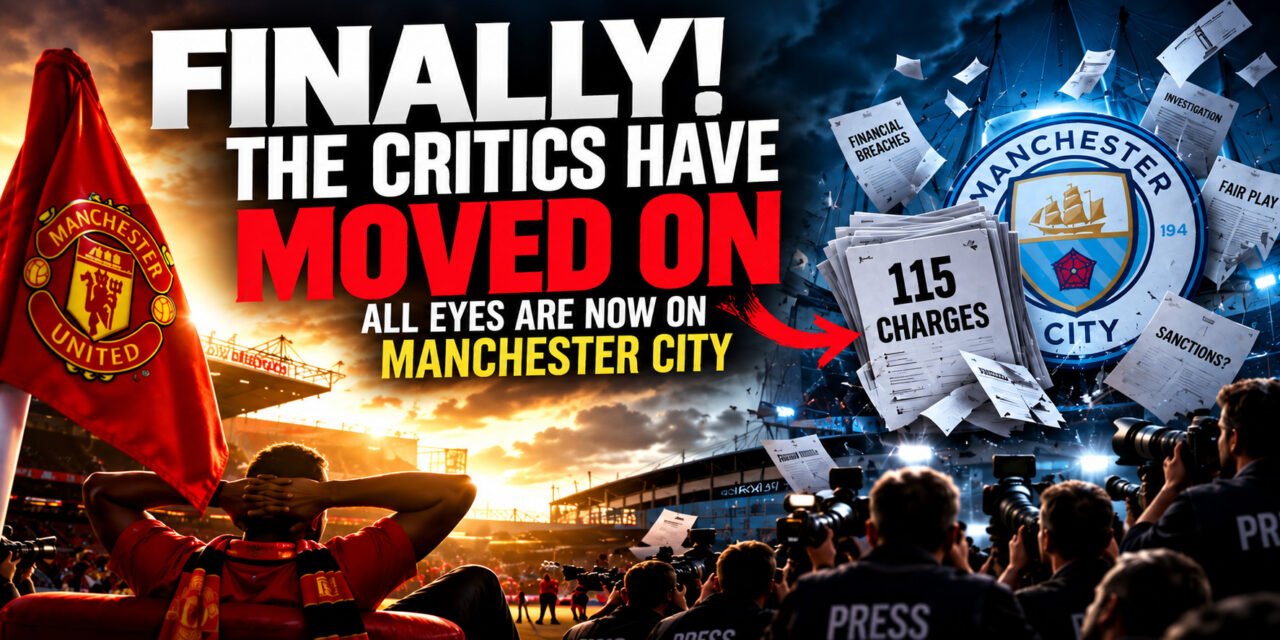
And then, suddenly, everybody looked across Manchester.
Welcome to the Spotlight, Neighbours!
Manchester City’s long-running financial case has finally become the story that swallows almost every other football conversation.
The case commonly known as the “115 charges” affair began when the Premier League charged City in February 2023 following a lengthy investigation. The precise number of alleged breaches has subsequently been counted differently because of the structure and amendments of the charges, but “115” became football’s shorthand for the case.
Now the story has moved dramatically beyond allegations.
On 29 September 2026, the Premier League announced that an independent Commission had found Manchester City guilty of all charges concerning serious breaches of the league’s financial rules over a nine-season period, as well as the majority of charges concerning failures to cooperate with the investigation.
The findings are extraordinary.
According to the Premier League’s published statement, the Commission found that between 2009-10 and 2017-18 City used commercial arrangements that misrepresented the true agreements between the parties, artificially inflated revenues and reduced costs. It also found that the club filed misstated accounts, concealed the true state of its finances from auditors and regulators, breached Premier League and UEFA spending limits, and committed multiple breaches of its obligations to cooperate with the investigation.
The Premier League says the arrangements at issue inflated revenues and reduced costs by more than £900 millionduring the affected period.
That is no ordinary football controversy.
And suddenly Manchester United’s latest tactical disaster doesn’t seem quite capable of dominating the news cycle.
United Fans May Recognise the Feeling
There is an irony here that United supporters can probably appreciate better than most.
For years, practically every aspect of Manchester United has been examined under a microscope.
How much did they spend?
How much did the player cost?
How much are they paying him?
Why hasn’t all that money produced more trophies?
Who approved the transfer?
Who appointed the manager?
Who is running the club?
What is happening with the stadium?
Why is the debt so high?
Why can’t Manchester United operate like Manchester City?
That last question was particularly common.
City became the model of modern football administration: intelligent recruitment, elite coaching, sophisticated structures and relentless winning.
United, meanwhile, became the counterexample.
One Manchester club supposedly represented how a modern football institution should operate.
The other represented dysfunction.
The independent Commission’s findings do not suddenly erase City’s extraordinary football, nor do they magically repair United’s mistakes. United remain responsible for United.
But they do make the comparison considerably more complicated.
Because the conversation surrounding Manchester City is no longer simply about how brilliantly the club was run.
It is also about the financial framework within which that success was constructed.
The Most Valuable Thing United Have Received: Silence
Manchester United have not suddenly become competent because Manchester City have a regulatory crisis.
That distinction matters.
City’s problems do not solve United’s problems.
A guilty finding against Manchester City does not improve United’s midfield.
It does not repair Old Trafford.
It does not undo poor recruitment.
It does not convert wasted transfer expenditure into good investment.
And it certainly does not put trophies retrospectively into the cabinet without further decisions from football’s authorities.
But City have given United something almost impossible to purchase in modern football:
a little breathing room.
For once, the biggest question in Manchester isn’t:
“What’s wrong with United?”
It is:
“What happens to City?”
That is a remarkable reversal.
The Premier League itself has described the disciplinary case and decision as the most significant in its history. The sanction has not yet been determined and will be addressed separately.
So the conversation is unlikely to disappear quickly.
Could there be points deductions?
Financial penalties?
Other sporting sanctions?
What happens to City’s historical achievements?
Could other clubs pursue claims?
And what does the whole episode mean for the credibility of the Premier League itself?
Those questions are now consuming English football.
United supporters can, for once, watch someone else’s crisis dominate the headlines.
There Is an Important Caveat
Manchester City emphatically reject the Commission’s conclusions.
In their official response, City said they were “disappointed and surprised” by the decision, maintained that the club is innocent and said the Commission’s opinion contains what City regard as material errors of law, principle and fact. The club has said it will pursue the appeal avenues available to it.
That matters.
The process is not finished.
The sanction is still to be determined, and City’s challenge to the findings means there may yet be substantial legal and regulatory proceedings ahead.
But whatever ultimately happens on appeal, something has already changed in football’s conversation.
The spotlight has moved.
Manchester United Should Enjoy This — But Also Learn From It
There is a temptation for United supporters simply to sit back with popcorn.
Understandable.
After years of jokes about United’s spending, ownership, recruitment, managers and decline, watching the football world devote its forensic energy elsewhere will feel almost therapeutic.
But United would be foolish to interpret City’s difficulties as vindication of everything happening at Old Trafford.
If anything, this is an opportunity.
When the cameras temporarily turn elsewhere, rebuild.
When every transfer is not the biggest story in English football, recruit intelligently.
When every managerial decision isn’t consuming the entire football news cycle, establish stability.
When your neighbour’s problems occupy football’s attention, quietly get your own house in order.
Because the critics haven’t disappeared.
They’ve merely crossed Manchester.
And eventually, they will come back.
For now, however, Manchester United supporters can experience one of football’s rarest pleasures:
being allowed to have problems in peace.