
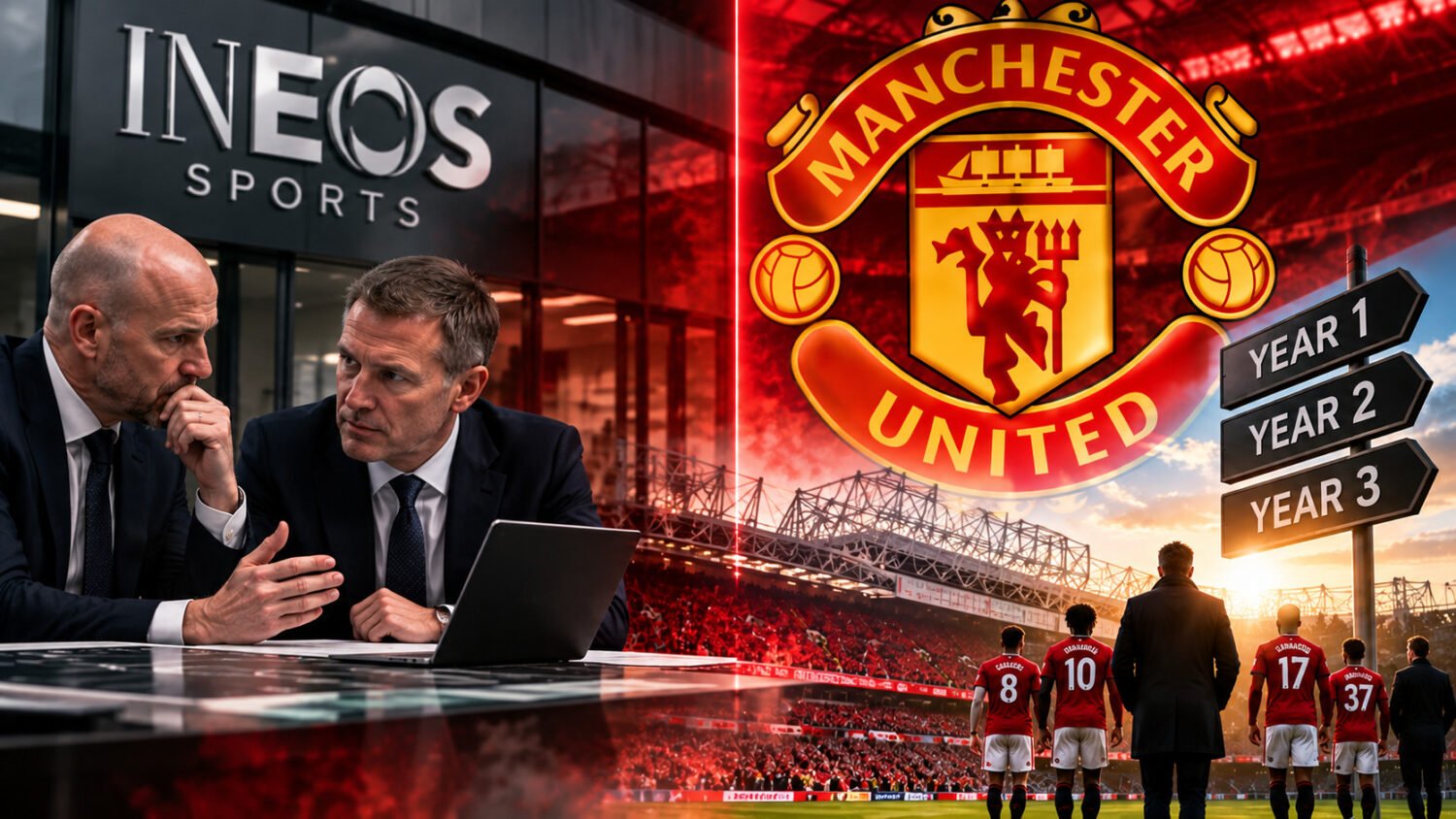
Manchester United have made a decision that could prove far more important than it currently appears.
For now, Michael Carrick remains the manager.
Following the 3–0 defeat to Bournemouth, with United languishing near the bottom of the Premier League and without a victory in eight matches, the pressure to dismiss Carrick became enormous. Director of football Jason Wilcox and chief executive Omar Berrada met at Carrington to discuss the situation. Alternatives were being considered. Carrick appeared to be approaching the end.
And then United did something unusual.
They stayed put.
Carrick was given the opportunity to continue.
It may prove temporary. Another defeat could reopen the entire discussion. Indeed, some reporting has characterised the decision less as a declaration of long-term faith and more as a stay of execution.
But perhaps Manchester United should go further.
Perhaps INEOS should resist the pressure not merely for another week, but long enough to discover whether something can actually be built.
Because if Manchester United genuinely believe Michael Carrick is capable of becoming the manager they appointed him to be, then the most important thing the new football structure can give him may not be another statement of support.
It is time.
Manchester United have tried the alternative
The argument for dismissing Carrick is easy to understand.
Manchester United should not be near the relegation places.
Eight matches without victory is unacceptable for a club of this stature.
The performances have been poor. The team has looked disjointed. Questions have emerged about tactics, recruitment, intensity and the relationship between manager and players.
At almost any major football club, those conditions place the manager in danger.
But Manchester United must consider their own history before reaching for the familiar solution.
They have changed managers repeatedly since Sir Alex Ferguson retired.
David Moyes came and went.
Louis van Gaal came and went.
José Mourinho came and went.
Ole Gunnar Solskjær came and went.
Erik ten Hag came and went.
Ruben Amorim came and went.
Now Michael Carrick is under pressure.
Different personalities.
Different philosophies.
Different tactical systems.
Different transfer requirements.
Yet remarkably similar endings.
At some point, an organisation must ask whether repeatedly changing the person at the front is actually changing the organisation.
Manchester United have conducted that experiment for more than a decade.
The results should encourage INEOS to try something different.
Don’t confuse patience with complacency
Giving Carrick time does not mean accepting failure.
This distinction is important.
Patience is not lowering standards.
Patience is recognising that high standards sometimes require a longer process to achieve.
Manchester United should still demand improvement from Carrick. The football must improve. Players must run. Tactical weaknesses must be corrected. Performances must become more consistent. Carrick must demonstrate that he is learning from mistakes and developing solutions.
But there is a significant difference between saying:
“Results don’t matter.”
and saying:
“Results matter, but they are not the only evidence by which we judge whether something worthwhile is being built.”
That is the type of distinction a serious sporting directorate must be capable of making.
Supporters naturally respond to Saturday.
Executives must also think about three years from Saturday.
That is their job.
This is where INEOS must prove its value
INEOS did not become responsible for Manchester United’s football operations merely to make the same decisions previous administrations made with different people sitting around the table.
The purpose of a sporting structure is supposed to be precisely this: to make football decisions according to a coherent long-term plan rather than emotion, headlines or public pressure.
Wilcox, Berrada and the wider football leadership therefore face a revealing test.
Can they distinguish between a manager who is failing because his project is fundamentally wrong and a manager struggling through the difficult stage of building something?
Those are not the same thing.
If they have concluded internally that Carrick lacks the tactical ability, leadership qualities or developmental capacity required to manage Manchester United, they should replace him.
But if they still believe in the qualities that persuaded them to appoint him permanently, then eight difficult matches should not suddenly erase that conviction.
Otherwise, what exactly was the original appointment based upon?
A football directorate should know considerably more about its manager than supporters watching from the stands or pundits analysing from television studios.
It sees training.
It knows the recruitment plan.
It knows what Carrick has requested.
It knows which positions remain incomplete.
It knows what the long-term tactical model is supposed to become.
It knows what is happening inside the dressing room.
And crucially, it knows whether the current Manchester United squad resembles the finished product Carrick was promised.
That information should matter more than noise.
Then give him the players
Patience alone will not solve Manchester United’s problems.
If INEOS keeps Carrick, it must support that decision with recruitment.
This is where the argument becomes uncomfortable for the club’s hierarchy.
Earlier this month, Lisandro Martínez publicly criticised the level of summer investment before subsequently apologising following talks involving Carrick, Wilcox and Berrada. Reporting around the episode also indicated that United’s leadership was working according to a transfer strategy sanctioned by Berrada and Sir Jim Ratcliffe.
If there is a strategy, now is the time to demonstrate it.
Carrick should not be handed random collections of expensive footballers.
He should be supplied, window by window, with players who solve identifiable problems within the football United are trying to build.
If midfield lacks athleticism, address it.
If the defence cannot sustain the required line, address it.
If the team lacks goals, address it.
If certain players cannot execute the pressing structure, find players who can.
And if individuals—regardless of reputation, salary or status—cannot embrace the standards of the new Manchester United, the club must eventually be prepared to move them on.
That is how rebuilding works.
Not by buying the most famous available player.
Not by responding to every defeat with another transfer.
And certainly not by buying players for one manager and then replacing that manager with someone who requires entirely different players.
Recruitment and coaching must finally become parts of the same idea.
Because Carrick is not only building a team
He is trying to restore a culture.
And culture is much harder to build than a starting XI.
You can purchase a footballer in one afternoon.
You cannot purchase standards.
You cannot purchase collective responsibility.
You cannot purchase trust.
You cannot purchase the expectation that every player runs for the man beside him.
Those things are established through repetition.
Training after training.
Match after match.
Decision after decision.
A player arrives late. What happens?
A senior player ignores tactical instructions. What happens?
A young player performs well. Is he rewarded?
The team loses badly. How does it respond?
A star player challenges the manager. Does the institution support the standards of the coach or the status of the player?
These apparently small moments eventually answer a much larger question:
What does it mean to play for Manchester United?
That answer cannot be written in a strategic document.
It has to become behaviour.
And behaviour takes time.
Every managerial reset resets part of the culture
This is one of the hidden costs of constantly changing managers.
A new manager does not simply bring a new formation.
He brings new expectations.
New terminology.
New training methods.
New tactical principles.
New ideas about leadership.
New assessments of existing players.
New transfer priorities.
And often, a new hierarchy within the dressing room.
Players who were essential become expendable.
Players who were expendable receive another opportunity.
Previous standards are renegotiated.
The clock starts again.
Sometimes that is necessary. A failing leader should not be retained indefinitely merely in the name of continuity.
But constant restarting has a cost.
Manchester United know that better than almost anyone.
The club has spent years rebuilding squads that were themselves assembled during previous rebuilds.
There comes a point when rebuilding must actually be allowed to become building.
Think in years, not weeks
Imagine Manchester United two or three years from now.
Not necessarily champions.
Not necessarily back at the summit of European football.
But recognisable.
A squad assembled deliberately around a football philosophy.
Young players who have spent several seasons learning the same principles.
Senior players who understand exactly what is expected.
Recruitment designed to strengthen specific positions rather than restart the project.
A manager whose authority has survived difficult periods.
A dressing room that understands that poor form will not automatically remove the coach.
And a football department capable of making decisions without being governed by the emotional temperature surrounding the club.
That Manchester United would be considerably healthier than one that simply hires another manager this winter and begins another revolution.
Could Carrick fail even with that support?
Of course.
Time guarantees nothing.
That needs to be acknowledged.
There is no rule in football saying that three years of patience transforms every manager into a great one. Stability without progress simply becomes stagnation.
The argument for keeping Carrick therefore cannot be based merely on patience.
It must be based on progress plus patience.
INEOS should establish milestones.
Is the style becoming clearer?
Are performances improving even when results fluctuate?
Are players developing?
Are new signings integrating into a coherent system?
Is the physical level improving?
Is the dressing-room culture strengthening?
Are recurring weaknesses being solved?
If the answers remain no over a meaningful period, then change becomes justified.
But those are very different criteria from:
“Did Manchester United win the last three matches?”
Look at how things are actually built
There is a broader lesson here that extends well beyond football.
Almost nothing worthwhile is built instantly.
Businesses take time.
Teams take time.
Relationships take time.
Institutions take time.
Character takes time.
Culture certainly takes time.
The early stages of building are often the least impressive because foundations are largely invisible.
When a building is being constructed, nobody looks at the foundations after three weeks and complains that there is still no penthouse.
Yet modern football increasingly expects managers to produce the penthouse while concrete is still being poured.
Manchester United cannot continue operating that way.
The club’s history makes patience difficult because its standards are extraordinarily high.
But its history should not become a prison.
Sir Alex Ferguson’s Manchester United was not created in a transfer window.
It became a culture.
Players arrived into something larger than themselves. Expectations were already established. Senior players transmitted standards to younger ones. The identity of Manchester United did not need to be reinvented every summer.
That is ultimately what the club must recover.
Not nostalgia.
Not Ferguson himself.
Continuity of standards.
The Brighton lesson still matters
In our previous article, we compared Manchester United with Brighton & Hove Albion.
The central argument was that Brighton’s strength is not simply identifying good managers.
It is building an institution in which managers operate inside a coherent football system.
That lesson becomes even more relevant now.
Manchester United cannot become Brighton simply by copying Brighton’s recruitment.
Nor should they want to.
United’s ambitions, resources, pressures and expectations are different.
But they can learn the principle.
The institution must eventually become stronger than the crisis.
One bad month cannot change the philosophy.
One transfer window cannot redefine the strategy.
One unhappy player cannot determine the culture.
And every run of poor results cannot automatically produce another managerial revolution.
Otherwise there is no project.
There is only reaction.
Backing Carrick means more than not sacking him
This is the crucial point.
Keeping Michael Carrick for another match is not a strategy.
Keeping him until the next international break is not a strategy.
Keeping him because a preferred replacement is unavailable is certainly not a strategy.
Real backing requires something much more difficult.
INEOS must decide whether Michael Carrick is the man they want building Manchester United.
If the answer is no, they should act decisively.
But if the answer is yes, then act like it.
Give him authority.
Give him appropriate players.
Allow him to make difficult decisions.
Support standards within the dressing room.
Recruit according to the football philosophy.
Judge development intelligently.
Accept that rebuilding will contain setbacks.
And give the project enough time for its principles to become habits and its habits to become culture.
That would represent something genuinely different at Manchester United.
Perhaps the brave decision is to do nothing
Football executives are often praised for acting decisively.
Sack the manager.
Appoint the replacement.
Announce the new era.
Promise change.
Sometimes decisive action is necessary.
But sometimes leadership is demonstrated by refusing to act simply because everyone is demanding action.
There are moments when staying the course requires more conviction than changing direction.
Manchester United may be approaching one of them.
Two or three years from now, INEOS could look back at this period very differently.
Perhaps Carrick will not ultimately prove to be the man. Football provides no guarantees.
But if the sporting directorate genuinely believes in him, surrounds him with the right recruitment, protects the standards required to rebuild the dressing room and gives those ideas enough time to mature, this difficult period could eventually be remembered not as the moment United failed to act—
but as the moment they finally stopped starting again.
Because great teams are not assembled.
They are built.
Great cultures are not announced.
They are lived.
And anything genuinely worth building requires something Manchester United have afforded far too few of their managers:
time.
Comments
No comments yet. Join the conversation.
Join the conversation. Log in to leave a comment.
Log in to comment