
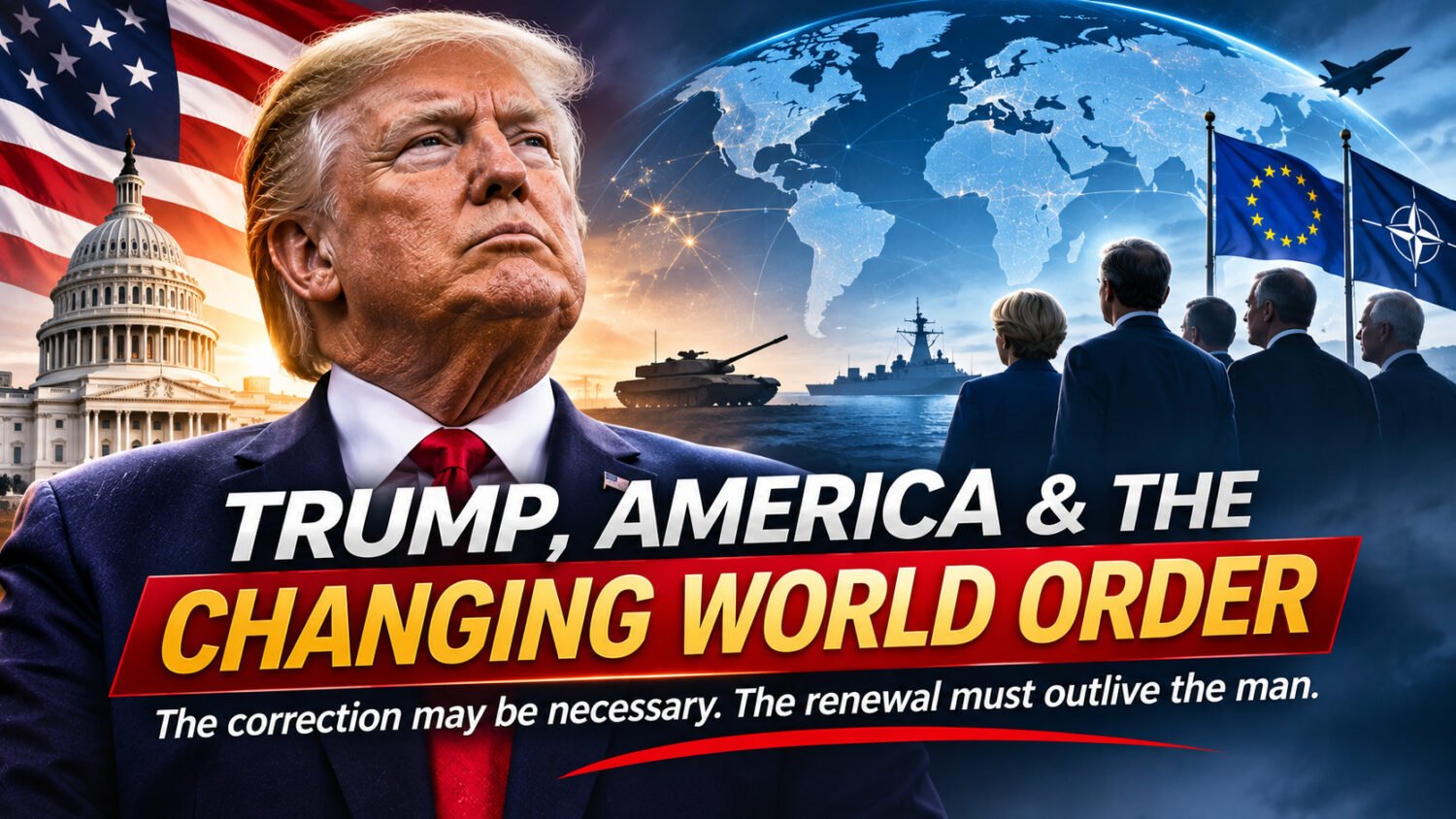
Donald Trump is an imperfect messenger for an argument America can no longer afford to ignore.
That distinction matters.
One does not have to excuse Trump’s failings, approve of every decision he makes, or embrace every aspect of his politics to recognise something larger happening beneath his presidency:
The world America built after the Second World War is changing, and America must change with it.
For decades, the United States has occupied an extraordinary position in the international system.
It helped defend Europe.
It guaranteed important shipping lanes.
It maintained military bases around the world.
It underwrote alliances across Europe and Asia.
It built institutions that facilitated global trade.
And through its economic, military and diplomatic power, America became one of the principal guarantors of an international order from which much of the democratic world benefited.
America benefited enormously too.
The dollar became the world’s dominant reserve currency. American companies gained access to global markets. Washington accumulated extraordinary diplomatic influence. American military power gave the country strategic reach unmatched by any competitor.
So the post-war system was never simply American charity.
It was an arrangement from which America derived enormous power and prosperity.
But arrangements created for one historical era cannot be assumed to remain optimal forever.
And the era is changing.
The world America inherited is disappearing
China is now an economic, technological and military competitor of a scale the Soviet Union never was economically.
Russia has demonstrated that large-scale war on the European continent is no longer something confined to history books.
Cyber warfare, artificial intelligence, drones and space capabilities are changing the meaning of national defence.
Supply chains have become questions of national security.
Industrial capacity matters again.
Energy security matters.
Semiconductor manufacturing matters.
And America’s ability to maintain overwhelming military superiority everywhere simultaneously cannot simply be assumed.
Washington itself now says its allies must assume greater responsibility. The Trump administration’s National Security Strategy explicitly argues that the United States “cannot, and should not have to” meet major security challenges alone, and calls on allies in Asia to increase their own defence contributions.
This is the environment in which Trump’s foreign policy should be understood.
Not merely as personality.
Not merely as nationalism.
But as one manifestation—however abrasive—of a deeper strategic recalibration.
Europe needed the shock
Trump’s criticism of NATO allies has frequently been controversial.
Sometimes unnecessarily so.
Alliances depend on trust, and rhetoric suggesting that American security commitments might become conditional can create precisely the uncertainty alliances are intended to prevent.
But underneath the rhetoric was a legitimate question:
Why should the wealthiest democratic alliance in history remain disproportionately dependent on one member for its military capacity?
The numbers demonstrate that the imbalance was real, although sometimes exaggerated in political debate.
In 2025, the United States accounted for approximately 52% of NATO’s combined GDP but around 60% of alliance defence expenditure. European allies and Canada represented roughly 48% of GDP but only 40% of defence spending.
Europe was not contributing nothing.
Far from it.
But the distribution was uneven.
And that is now changing.
At NATO’s 2025 Hague Summit, allies agreed to move toward spending 5% of GDP on defence and defence-related security investment by 2035, including at least 3.5% for core military requirements.
European allies and Canada increased their defence expenditure by nearly 20% in real terms in 2025 alone.
By 2026, NATO Secretary General Mark Rutte was openly describing European and Canadian defence spending as moving towards greater balance with the United States—and specifically credited Trump’s pressure with helping produce what he called a needed “shot of adrenaline.”
That is significant.
Whatever one thinks of Trump, the conversation has changed.
This is not America abandoning the West
This distinction is critical.
The answer to excessive American burden is not American isolation.
That would be strategically shortsighted.
America’s alliances are assets.
NATO extends American influence across Europe.
Japan and South Korea anchor American power in Asia.
Australia, Canada and Britain provide military, intelligence and diplomatic capabilities that Washington would otherwise have to replace itself.
An America without allies would not necessarily become stronger.
It could become more alone.
The better objective is therefore not the destruction of the Western alliance.
It is its maturation.
For too long, parts of Europe could treat American military protection almost as a permanent feature of the natural environment.
That era should end.
Europe must increasingly possess the capability to defend Europe.
Asian allies must assume greater responsibility for Asian security.
Canada must contribute according to its capacity.
And America should remain the indispensable partner within those alliances without remaining their permanent substitute.
That is not the end of the Western order.
It may be what saves it.
America also has rebuilding to do at home
But asking allies to spend more is only half the correction.
America must ask itself a much harder question:
What is American power ultimately for?
A country can possess the world’s most powerful military and still become weaker internally.
National strength is also industrial capacity.
Infrastructure.
Education.
Science.
Energy.
Technological leadership.
Healthy institutions.
Fiscal sustainability.
Social trust.
A functioning political culture.
And citizens who still believe they share something worth defending.
This is where Trump’s disruption becomes insufficient.
He can challenge assumptions.
He can force allies to reconsider burden-sharing.
He can demand that American interests receive greater priority.
He can accelerate conversations Washington’s foreign-policy establishment might otherwise have postponed.
But disruption is not the same thing as renewal.
Breaking an old consensus is easier than constructing a better one.
Trump cannot finish what Trump started
No president can.
That may be the most important point.
American political debate has become dangerously personalised.
Everything becomes Trump.
For Trump.
Against Trump.
Defend Trump.
Stop Trump.
But the United States is older than Donald Trump and, if its institutions remain healthy, will long outlive him.
The strategic questions now facing America will still exist after he leaves office.
How much should America spend defending Europe?
How should China be deterred?
What industries must be maintained domestically for national security?
How should America’s enormous national debt affect its global ambitions?
What should allies contribute?
What should American leadership look like when American dominance is no longer unquestioned?
Those are not Trump questions.
They are American questions.
And eventually Americans across the political spectrum will have to answer them.
Recovering America’s soul
There is also something deeper at stake.
America cannot rediscover national strength merely by becoming harder.
Strength without principle can become something else entirely.
The extraordinary power of the American project was never simply aircraft carriers, GDP or nuclear weapons.
It was an idea.
A constitutional republic.
Government constrained by law.
Individual liberty.
Freedom of expression.
Religious freedom.
Democratic transfer of power.
The proposition—imperfectly realised throughout American history—that human beings possess rights government does not create and therefore should not casually remove.
America has frequently failed its own ideals.
Slavery stands as the most obvious contradiction.
Segregation followed.
There have been unjust wars, political abuses, discrimination and enormous failures of judgment.
But the remarkable feature of the American system has often been its capacity for self-correction.
The abolitionist could appeal to American principles against American practice.
The civil-rights movement could demand that the country honour promises already embedded in its founding language.
America’s soul therefore does not lie in pretending America has always been right.
It lies partly in preserving its capacity to recognise when it is wrong and correct itself.
That is the part of America no geopolitical strategy should sacrifice.
The West must grow up
The same principle applies to America’s allies.
A genuine partnership cannot indefinitely consist of one partner assuming disproportionate responsibility while everyone insists the arrangement must never change.
Europe’s growing defence investment should therefore not be interpreted simply as capitulation to Trump.
It can be understood as strategic adulthood.
The 2025 NATO agreement explicitly reaffirmed Article 5—the principle that an attack against one ally is an attack against all—while simultaneously committing members to substantially greater defence investment.
Those ideas belong together.
Greater European responsibility does not have to mean weaker transatlantic solidarity.
Properly executed, it could produce the opposite.
A stronger Europe.
A less overstretched America.
A more credible NATO.
And an alliance whose military responsibilities better reflect the economic capacities of its members.
America needs one more reinvention
The United States has reinvented itself before.
After the Civil War.
During industrialisation.
Through the Great Depression.
After the Second World War.
During the Cold War.
After the technological revolution.
Each era required Americans to rethink what national strength meant.
This may be another such moment.
The objective should not be to retreat from the world.
Nor should it be to preserve every commitment simply because it existed yesterday.
America needs something more difficult:
strategic discipline.
Know what must be defended.
Know what allies should increasingly defend themselves.
Know which industries cannot safely disappear.
Know where American military power is indispensable.
Know where diplomacy produces better outcomes.
Know when national interest and international responsibility reinforce each other.
And above all, know what kind of country all that power exists to protect.
Trump may have forced America and its allies to confront questions they preferred postponing.
History will judge his methods and consequences far more comprehensively than we can today.
But the strategic correction now underway cannot depend upon one man.
Nor should it.
The West must take greater responsibility for its collective defence.
America must rebuild the foundations of its own power.
Its allies must become stronger partners rather than permanent dependants.
And Americans themselves must rediscover a national purpose capable of surviving elections, personalities and parties.
Because ultimately America’s challenge is larger than Donald Trump.
The world order is changing.
America must change with it.
But in changing, America must be careful not to discard the very things that made its leadership worth following.
Trump may be part of the correction.
Americans must decide what comes after it.
Comments
No comments yet. Join the conversation.
Join the conversation. Log in to leave a comment.
Log in to comment